Mostrar mensagens com a etiqueta Vegan. Mostrar todas as mensagens

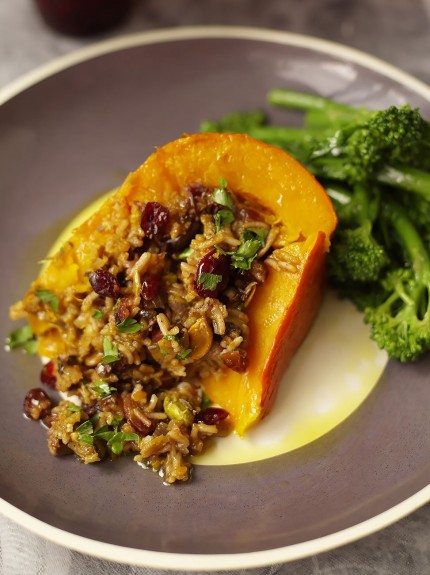
The best baked pumpkin

Stuffed with nutty, fruity rice
“Oven-baked pumpkin is beautiful with spices, like in this really impressive veggie dish ”
Serves 4
Cooks In1H 30M
Difficulty Not too tricky
Vegetables, Halloween/Bonfire Night, Gluten-free, Vegetarian

Nutrition per serving
Calories 587 29%
Fat 48.3g 69%
Saturates 7.4g 37%
Protein 5.9g 13%
Carbs 32.3g 12%
Sugars 17.9g 20%
Salt 0.93g 16%
Fibre 4.9g
Of an adult's reference intake

Ingredients
1 pumpkin, about 1kg
2 cloves garlic, peeled
olive oil
1 red onion , peeled and finely chopped
1 small handful black olives, stoned and chopped
2 sprigs of fresh rosemary, leaves finely chopped
1 dried chilli
sea salt
freshly ground black pepper
½ teaspoon ground nutmeg
½ teaspoon ground cinnamon
50 g basmati rice , washed and drained
75 g dried cranberries
50 g shelled pistachio nuts
1 tangerine , zest of
200 ml organic vegetable stock


Method
Pumpkins are so versatile, the things you can do with them are endless! Their flavour goes well with chilli, nutmeg and sage. If you’ve never cooked one before, you’re in for a real treat.
Preheat the oven to 230ºC/450ºF/gas 8. Cut the lid off the pumpkin and reserve it. Scoop out the seeds with a spoon and keep them to one side. Make the hollow where the seeds were a little bigger by scooping out some more pumpkin flesh. Finely chop this pumpkin flesh and one of the garlic cloves. Heat a frying pan over a medium heat. Pour in a splash of olive oil, then add the chopped pumpkin, chopped garlic, onion, olives, and half the rosemary. Cook gently for 10 minutes or so until the pumpkin has softened.
Meanwhile, place the whole garlic clove and the remaining rosemary in a pestle and mortar. Crumble in the dried chilli, add a good pinch of salt, pepper, nutmeg and cinnamon and bash until you have a paste. Add a little olive oil to loosen up the mixture and then rub the inside of the pumpkin with it.
Season the cooked pumpkin mixture and stir in the rice, cranberries, pistachios and tangerine zest with a pinch each of nutmeg and cinnamon. Mix thoroughly then add the vegetable stock, bring to the boil and simmer for 3 minutes (no longer or the rice will end up overcooked later).
Tear off a sheet of tin foil that’s large enough to wrap the pumpkin in a double layer and lay on top of a baking tray. Place the pumpkin on top and spoon the rice mixture into it, then place its lid back on. Rub the skin with a little olive oil, wrap it up in the foil and bake in the oven for about an hour. The pumpkin is ready when you can easily push a knife into it. Bring it to the table and open it up in front of everyone. Cut it into thick wedges and tuck in, leaving the skin. Serve with seasonal greens.

Everyday green chopped salad

With easy homemade dressing and nuts
“This just goes to show that even the simplest green salad can pack a real flavour punch ”
Serves 4
Cooks In 10 minutes
Difficulty Super easy
Vegetables, Dairy-free, Vegan, Vegetarian

Nutrition per serving
Calories 94 5%
Fat 7.9g 11%
Saturates 1.1g 6%
Protein 1.8g 4%
Carbs 2.7g 1%
Sugars 2.1g 2%
Of an adult's reference intake

Ingredients

4 scallions
½ cucumber
1 handful fresh basil leaves
½ head Boston lettuce , or small red leaf lettuce
½ heart romaine
½ cup sprouted cress or alfafa
3 tablespoons extra virgin olive oil
1 tablespoon red wine vinegar
½ teaspoon Dijon or English mustard
⅛ teaspoon sea salt
freshly ground black pepper
½ cup chopped toasted walnuts , or your favourite nuts


Method
Chopped salads are incredibly simple to make, you have to give them a go. If nothing else, they can offer you some chopping practice, so why not make something tasty while you’re practicing your knife skills? Anyone can make these salads, just make sure you use a good, sharp chef’s knife and your biggest chopping board – and watch your fingers!

Get yourself a big chopping board and a large sharp knife. It’s best to start by chopping the harder, crunchier veggies first, so trim and chop your scallions and slice your cucumber. Slice your basil. Bring it all into the centre of the board, and continue chopping and mixing together.
Add the lettuce leaves, and cress or alfalfa to the board. When everything is well chopped, you’ll have a big mound of salad on the board.
Make a well in the middle and drizzle in the extra virgin olive oil and red wine vinegar. Add the mustard and the salt and pepper. Sprinkle with nuts. Mix up so everything gets well coated and serve on the board or in a bowl.
Serving suggestions:
This makes a nice addition to any main dish such as Barbecued chicken, Spaghetti and meatballs or Old-school pork chops with apples.
Jamie's tips:
- What I want to show you here is that the sky’s the limit when it comes to the different ingredients you can add to a chopped salad – you can use whatever’s available.
- The only rule I would give you is to always include a couple of handfuls of crunchy lettuce to give your salad a really good texture. Try out different things, and don’t feel obliged to use the same old stuff all the time. Bell peppers, tomatoes, herb sprigs, a peeled and pitted avocado . . . you can get any or all of these into a chopped salad.
- Basil works well in this salad, but so do lots of other soft fresh herbs, such as chives, chervil, or mint.
- For a bit of extra crunch, simply toast some nuts in a warm pan, but watch them as once they start to go brown they can burn very quickly.

I’ve converted to veganism to reduce my impacts on the living world

Illustration by Nate Kitch
por George Monbiot.

"Nothing hits the planet as hard as rearing animals. Caring for it means cutting out meat, dairy and eggs.

The world can cope with 7 or even 10 billion people. But only if we stop eating meat. Livestock farming is the most potent means by which we amplify our presence on the planet. It is the amount of land an animal-based diet needs that makes it so destructive.

An analysis by the farmer and scholar Simon Fairlie suggests that Britain could easily feed itself within its own borders. But while a diet containing a moderate amount of meat, dairy and eggs would require the use of 11m hectares of land (4m of which would be arable), a vegan diet would demand a total of just 3m. Not only do humans need no pasture, but we use grains and pulses more efficiently when we eat them ourselves, rather than feed them to cows and chickens.

This would enable 15m hectares of the land now used for farming in Britain to be set aside for nature. Alternatively, on a vegan planet, Britain could feed 200 million people. Extending this thought experiment to the rest of the world, it’s not hard to see how gently we could tread if we stopped keeping animals. Rainforests, savannahs, wetlands, magnificent wildlife can live alongside us, but not alongside our current diet.

Because we have failed to understand this in terms of space, we believe we can solve the ethical problems caused by eating animals by switching from indoor production to free-range meat and eggs. Nothing could be further from the truth. Free-range farming is kinder to livestock but crueller to the rest of the living world.

When people criticise farming, they usually preface it with the word intensive. But extensive farming, almost by definition, does greater harm to the planet: more land is needed to rear the same amount of food. Keeping cattle or sheep on ranches, whether in the Amazon, the US, Australia or the hills of Britain, is even more of a planet-busting indulgence than beef feed-lots and hog cities, cruel and hideous as these are.

Over several years, as I became more aware of these inconvenient truths, I gradually dropped farmed meat from my diet. But I still consumed milk and eggs. I knew the dire environmental impacts of the crops (such as maize and soya) that dairy cows and chickens are fed. I knew about the waste, the climate change, the air pollution. But greed got the better of me. Cheese, yoghurt, butter, eggs – I loved them all.

Then something happened that broke down the wall of denial. Last September I arranged to spend a day beside the River Culm in Devon, renowned for its wildlife and beauty. However, the stretch I intended to explore had been reduced to a stinking ditch, almost lifeless except for some sewage fungus. I traced the pollution back to a dairy farm. A local man told me the disaster had been developing for months. But his efforts to persuade the Environment Agency (the government regulator) to take action had been fruitless.

I published the photos I had taken in the Guardian, and they caused a stir. Yet the Environment Agency still refused to take action. Its excuses were so preposterous that I realised this was more than simple incompetence. After publishing another article about this farce, I was contacted separately by two staff members at the agency. They told me they had been instructed to disregard all incidents of this kind. The cause, they believed, was political pressure from the government.

That did it. Why, I reasoned, should I support an industry the government refuses to regulate? Since then, I have cut almost all animal products from my diet. I’m not religious about it. If I’m at a friend’s house I might revert to vegetarianism. If I’m away from home, I will take a drop of milk in my tea. About once a fortnight I have an egg for my breakfast, perhaps once a month a fish I catch, or a herring or some anchovies (if you eat fish, take them from the bottom of the food chain). Perhaps three or four times a year, on special occasions, I will eat farmed meat: partly out of greed, partly because I don’t want to be even more of a spectre at the feast than I am already. This slight adaptation, I feel, also reduces the chances of a relapse.

I still eat roadkill when I can find it, and animals killed as agricultural pests whose bodies might otherwise be dumped. At the moment, while pigeons, deer, rabbits and squirrels are so abundant in this country and are being killed for purposes other than meat production, eating the carcasses seems to be without ecological consequence. Perhaps you could call me a pestitarian.

Even so, such meals are rare. My rough calculation suggests that 97% of my diet now consists of plants. I eat plenty of pulses, seeds and nuts and heaps of vegetables. That almost allows me to join the 500,000 people in Britain who are full vegans – but not quite. Of course, these choices also have impacts, but they are generally far lower than those of meat, dairy and eggs. Paradoxically, if you want to eat less soya, eat soya directly: eating animal products tends to mean consuming far more of this crop, albeit indirectly. Almost all the soya grown where rainforests once stood is used to feed animals. Replacing meat with soya reduces the clearance of natural vegetation, per kilogram of protein, by 96%.

After almost a year on this diet, I have dropped from 12 stone to 11. I feel better than I’ve done for years, and my craving for fat has all but disappeared. Cheese is no more appealing to me now than a lump of lard. My asthma has almost gone. There are a number of possible explanations, but I wouldn’t be surprised if it had something to do with cutting out milk. I have to think harder about what I cook, but that is no bad thing.

Meat eating is strongly associated with conventional images of masculinity, and some people appear to feel threatened by those who give up animal products. An Italian politician this week proposed jailing parents who impose a vegan diet on their children, in case it leaves them malnourished. Curiously, he failed to recommend the same sanction for rearing them on chips and sausages.

By chance, at a festival this summer, I again met the man from Devon who had tried to persuade the Environment Agency to take action on the River Culm. He told me that nothing has changed. When there’s a choice between protecting the living world and appeasing powerful lobby groups, most governments will take the second option. But we can withdraw our consent from this corruption. If you exercise that choice, I doubt you will regret it.